




Private equity fees are very high
The single most reliable predictor of future fund performance, as research by Morningstar has consistently shown, is cost. Simply put, the less you pay in fees and charges, the more you keep for yourself, and, generally speaking, the higher your eventual returns will be. The importance of controlling your costs applies just as much to investing in private companies as it does to investing in public ones. There is no other way of saying it: private equity fees, relatively speaking, are very high. There are currently 17 funds of the Association of Investment Companies’ private equity sector, and 11 of them have fees of 1.5% or more. The most expensive fund, by a large margin, is LMS Capital, with an ongoing charge of 4.12%. It has also produced a negative return over one, five and ten years. As of 30th November 2023, its return over ten years is -60.67%. The next most expensive is Abrdn Private Equity Opportunities, at 2.73%. It has performed much better, returning 207.46% over ten years. There are three other firms with charges in excess of 2.5% — Oakley Capital Investments, JPEL Private Equity and JZ Capital Partners. Again, their returns are very widely dispersed. Over ten years, the funds have returned 186.55%, 39.16% and -57.76% respectively. Expressed as percentages, these charges may seem modest, but, compared to fees for public equity funds, they are eye-wateringly high. You should also bear in mind that the AIC’s figures do not include performance fees. Compounded over many years, the impact on investors’ eventual net returns will be huge.“Not an asset class”
“Private equity is not an asset class,” says Nicolas Rabener, founder of the portfolio analysis fintech Finominal. “It is simple equity exposure in an expensive and illiquid fund structure and is best avoided, especially by retail investors.” Rory Maguire, managing director of the investment consultancy Fundhouse, also urges caution. “In theory this sector is attractive because there are arguably fewer buyers and sellers than in the listed market,” he says, “making it more likely you will find an undiscovered or mispriced idea. “But in practice we find that it is very hard to evidence that any gains make it back to clients. Fees are usually high and opaque. Therefore we tread incredibly carefully in this space and don’t recommend any 100% private equity funds to our clients.”How returns compare with public equities
Of course, private equity funds will tell you that they aim to deliver outsize returns. But a study published in August this year showed that, since 2008, exposure to private equity has made no contribution at all to the generation of alpha, or excess returns, by US pension funds. Although it is true that private companies used to outperform public stock markets, ongoing research by Cambridge Associates shows that this is no longer the case. As you can see from the chart below, most investors would have been better off investing in an S&P 500 index tracker over the last 15 years than a private equity fund.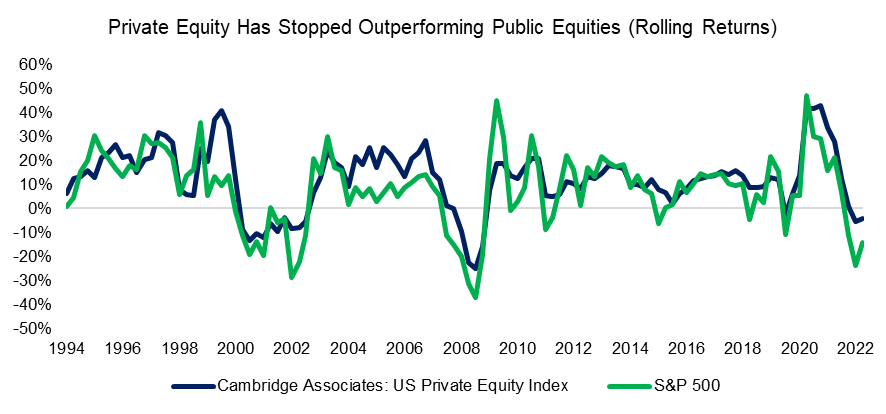
Better ways to gain exposure
For those who do want exposure, there are cheaper ways to access private equity returns than using a traditional actively managed fund. There are now a number of private-equity-themed ETFs available, although Nicolas Rabener points out that these primarily provide exposure to private equity holdings companies, which is not the same as investing directly in private equity. Nor does he expect private equity to replicate the outperformance it used to produce any time soon. "The structural tailwinds of private equity returns were rising valuations and falling interest rates,” he says. “But these winds are now blowing in the opposite direction." Another point that Rabener makes is that if you have already exposure, as rockwealth clients overwhelmingly do, to small company stocks and value stocks, there is little point in investing in a private equity fund as well. “Private equity is effectively a leveraged bet on small-cap value stocks,” he says. “You can replicate that exposure much more cheaply and efficiently via low-cost passive funds."CAN WE HELP?
If you’re looking for a financial planner, why not get in touch?
Our headquarters are in Cheltenham, but we have a number of offices around the UK, and we also work with clients remotely, via online video.
If we can’t help you, or feel you would be better speaking to someone else, we will be happy to point you in the right direction.
© rockwealth MMXXIII