The world, they say, is a global village. Nowhere is this truer than in investing. We firmly believe in taking a global approach to investing. But what does it mean to be a global investor, and why should anyone care?
When we say we’re ‘investing in the global capital market’, we mean buying tiny bits of some 43,000 publicly listed companies across the world with a collective value of around £57 trillion!
This means, that as an investor in the global stock markets, some 43,000 CEOs and millions of employees go to work every day to make you richer! They produce goods and services, which they sell to each other and the rest of the world. Therefore, as a global equity investor, you’re investing... heck, banking on the collective effort, creativity and intelligence of these CEOs and their armies of employees.
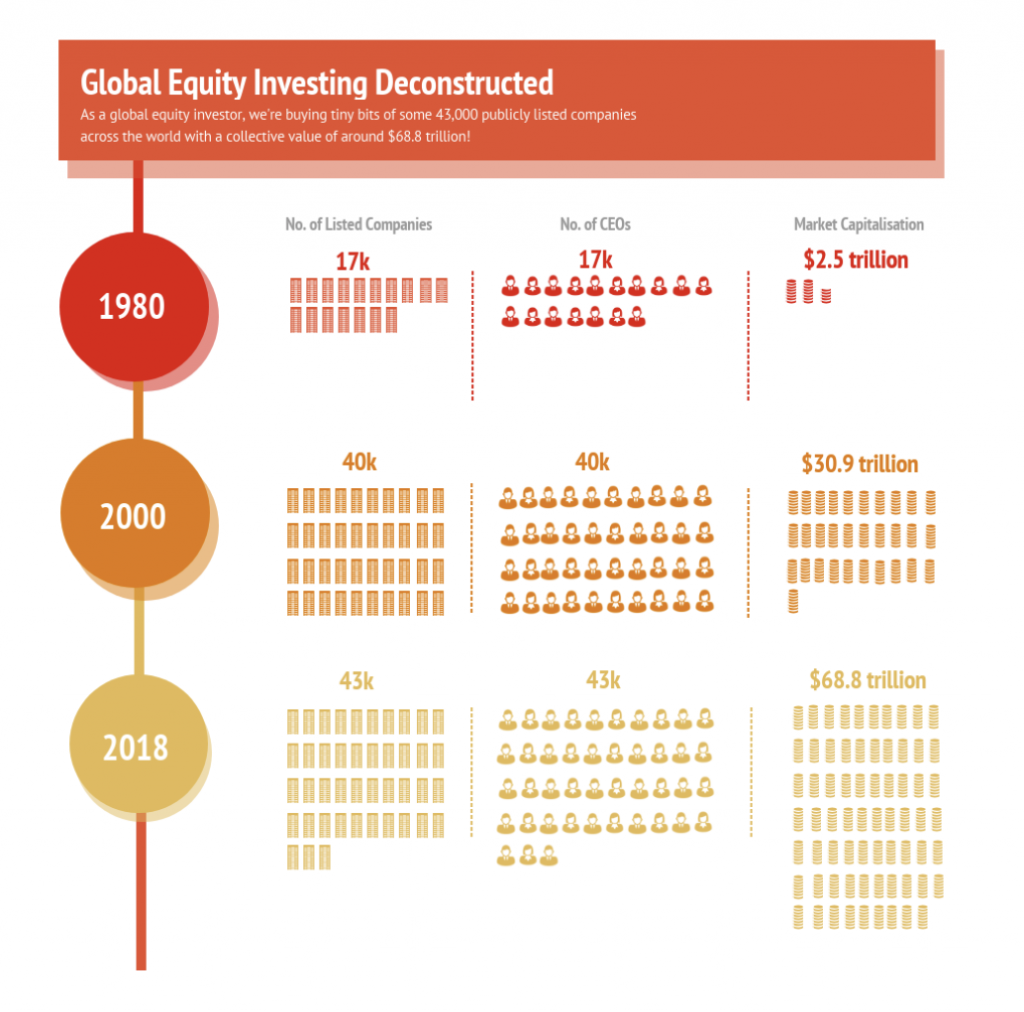 Source: World Federation of Exchanges. ©2019 FinalytiQ Limited. All rights reserved.
By implication, you profit from the collective performance of these companies. This is what legendary investor Jack Bogle meant when he said that ‘the stock market is a giant distraction from the business of investing’. In the long run, he noted, ‘investing is not about stock markets at all but about enjoying the returns earned by businesses.’
So rather than saying 'we're investing in the global stock market’, we really should be saying 'we are investing in the great companies of the world. We're backing their CEOs and employees to create and sell goods and services that other people want and need. They are investing in their collective intelligence, creativity and efforts.’
Now, it's not impossible that these companies will collectively fail to turn a profit in any single year. When they do well, your investments do well. When they don't, your investments don't. But over the long term, the overall direction of travel is that they are producing more, selling more and generally finding better ways to serve their customers. This means that over time, the values of these companies tend to go up.
For instance, the collective value of global stock markets stood at $2.5 trillion in 1980, according to the World Bank. By 2000, it had reached $30.9 trillion, $60 trillion by 2007, only to dip back to $32.2 trillion during the financial crisis of 2008. But that was temporary, these companies soon resumed their advance, reaching a whopping $68.8 trillion (£57 trillion) at the end of 2018.
What's more, new companies are being created every day, and many of these ultimately make their way to the stock market as they seek capital to grow and invite other people to participate in their success.
For instance, the World Bank recorded 17,000 publicly limited companies globally in 1980. By 2000, the number had more than doubled to 40,000! Today, there are 43,000 of them!
Thinking of investing this way brings confidence and clarity. It becomes crystal clear that you are not gambling on the stock-market. We are investing in real businesses, managed by real people, creating and selling real products and services in over 195 countries. While the stock market may fluctuate and the world at large is always in flux, a £57 trillion basket of some 43,000 companies cannot be inherently unstable. Governments come and go. But every day, 43,000 CEOs and millions of their employees across the world go to work to do the best they can, for themselves and for you, the investor and ultimate owner of these companies.
Performance of Major Asset Classes
‘Imagine it, dear reader: a couple with 40 years to live, making investment policy out of today’s terror headlines. This isn’t confusion; it’s daylight madness.’
- Nick Murray
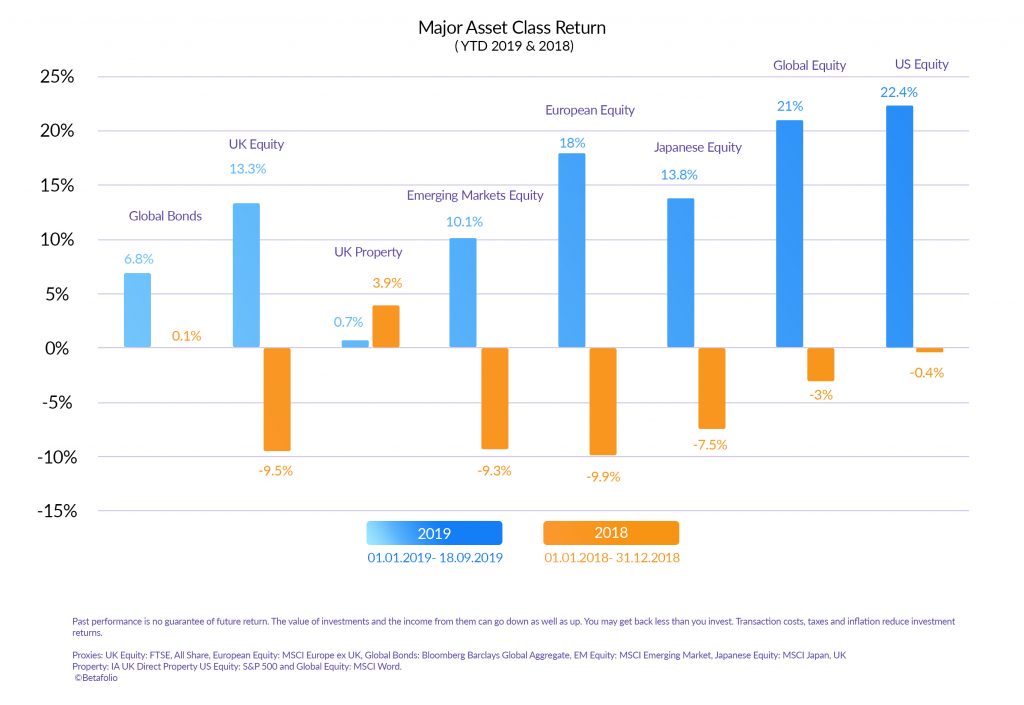
The chart below shows the performance of major asset classes for the whole of 2018, and year-to-date in 2019.
 Source: FE Analytics
When the capital markets wobbled during the last quarter of 2018, the financial journalists went into alarmist overdrive. They were all too quick to roll out their fear-inducing headlines. But when the markets recovered in the first few months of 2019, they were unsurprisingly silent.
It’s worth pointing out here, that if an investor acted in response to these headlines, panicked and sold their investments, they would have missed out on the subsequent rebound.
The lesson here is this, to succeed as an investor, we need to learn to ignore the alarmist financial headlines.